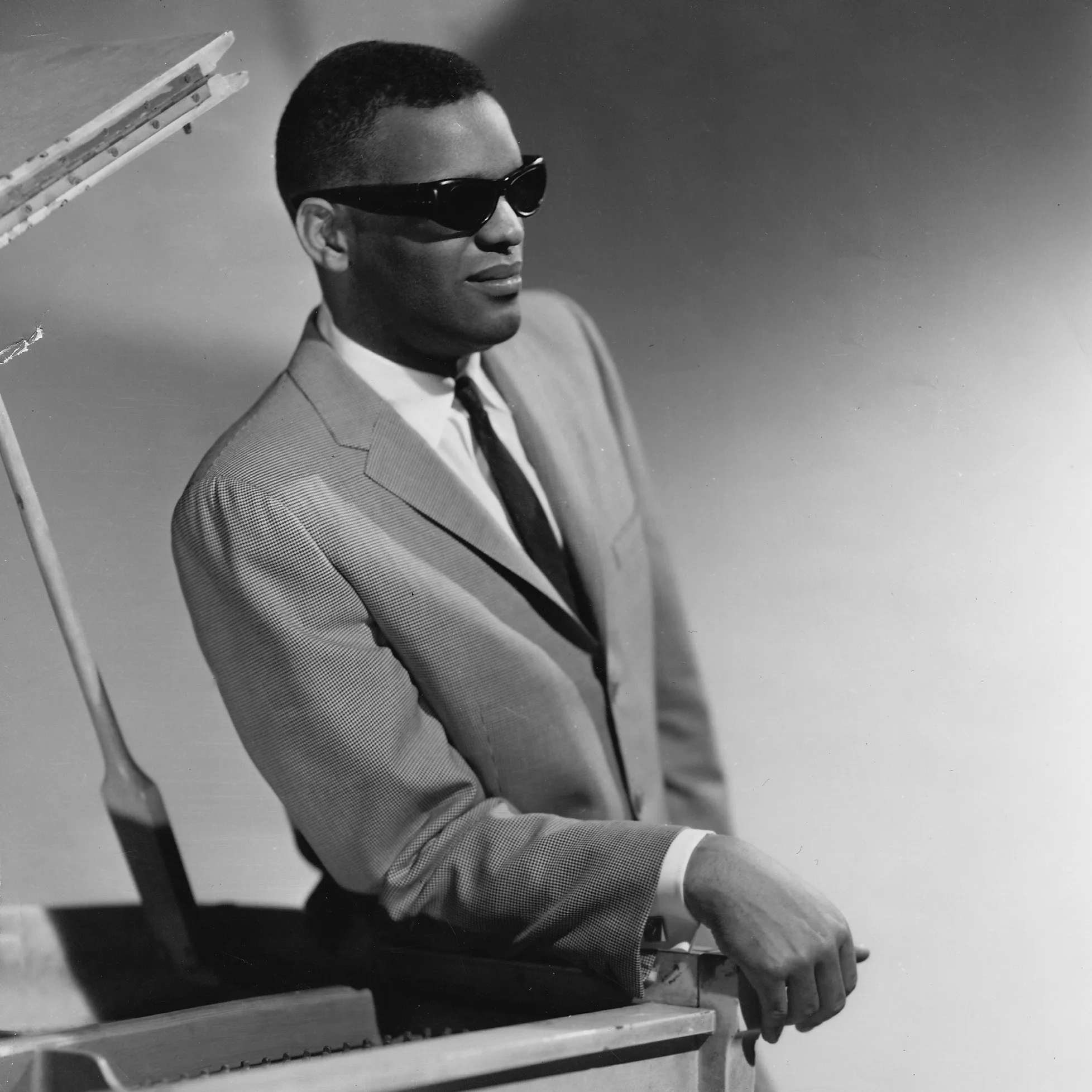
Ray Charles
Often called the Genius, Ray Charles pioneered soul music in the 1950s by bringing gospel and blues together. He won 17 Grammy Awards, and his final album, Genius Loves Company, sold over five million copies and won Album of the Year. In 1979 Georgia made his recording of “Georgia on My Mind” its official state song; in 1986 he was among the original inductees of the Rock and Roll Hall of Fame and received the Kennedy Center Honors; and in 2013 the United States Postal Service added him to its Music Icons Forever stamp series. “What’d I Say” comes in at 80 on Rolling Stone’s 500 Greatest Songs of All Time (2021). The Ray Charles Foundation, which he endowed in 1986, supports work on hearing disorders and the education of young people.
Ray Charles Robinson’s life began on September 23, 1930, in Albany, Georgia; raised in Greenville, Florida, he began losing his sight at five and was fully blind by seven. From 1937 to 1945 he studied composition and learned several instruments at the St. Augustine School for the Deaf and the Blind. He moved to Seattle in 1947, where his first band, the McSon Trio, hosted a weekly television show, and he signed his first label deal in 1948, modeling his early records on the R&B of Nat “King” Cole and Charles Brown.
In 1952 he signed with Atlantic Records, where he brought the sound of the church into his singing, and in 1955 “I Got a Woman” became his first national hit. “What’d I Say” was a hit in 1959, and that year he moved to ABC-Paramount, becoming the first major recording artist to negotiate ownership of his recordings with a label. There he made jazz records with the singer Betty Carter, cut “Georgia on My Mind,” the first of his three career number one hits, and turned to country: Modern Sounds in Country and Western Music (1962) became his first album to top the Billboard 200, and his country recording “I Can’t Stop Loving You” went to number one on the pop chart and won a Grammy. He recorded 15 LPs between 1949 and 1963, then spent the following decades on pop standards, show tunes, and country, returning to the country charts in the early 1980s.
Charles died on June 10, 2004. He received the Grammy Lifetime Achievement Award in 1987, the National Medal of Arts in 1993, and Sweden’s Polar Music Prize in 1998, and France made him a Commander of Fine Arts and Letters. “What’d I Say” is in the Library of Congress’s National Recording Registry, and Rolling Stone’s 500 Greatest Albums of All Time (2020) puts Modern Sounds in Country and Western Music at number 127.
The biopic Ray (2004) became one of the highest-grossing biopics in history, and “I Got a Woman” was sampled in Kanye West’s “Gold Digger.” In 2005 Congress renamed a Los Angeles post office the Ray Charles Station, and in 2010 the Ray Charles Performing Arts Center opened at Morehouse College. In May 2020 Primary Wave Music Publishing acquired his pre-1964 catalog. The Ray Charles Memorial Library opened on what would have been his 80th birthday, September 23, 2010.